
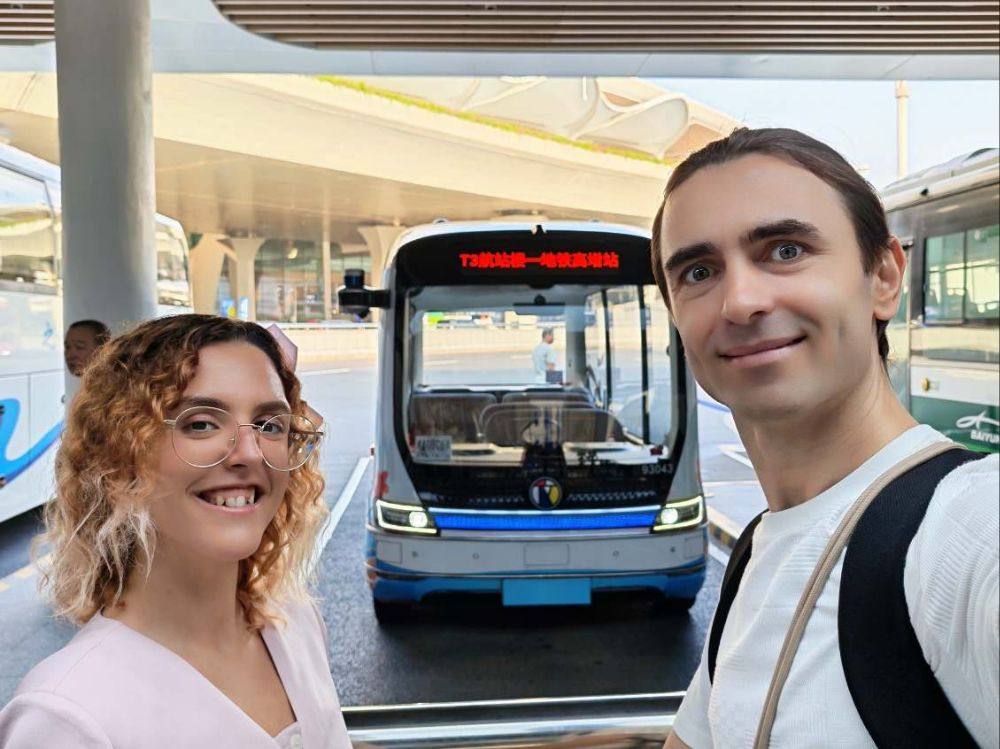
As sci-fi writers and editors, we spend our days imagining what the world will look like in fifty years. We script out AI takeovers, hover-trains, and silent, electric cities. But today, we didn’t have to imagine any of it. Today, we lived it.
We just touched down in Guangzhou, China, and instead of finding a chaotic taxi queue, we found a sleek, white pod waiting for us. This is the Autonomous Shuttle Bus, and it is the future happening right now.
The Reality of a Driverless Pod
Stepping up to the platform, the first thing that hits you is the silence. There is no engine idling, no driver tapping the wheel.
Stepping Into a Real-Life Sci-Fi Scene
The shuttle is parked exactly where the green sign reads «Please Line Up Here.» As we boarded, we realized we weren’t just tourists; we were test subjects in a beautiful, functional experiment. The bus has no steering wheel, no pedals, and no captain. Just code, sensors, and a smooth electric whisper. It felt like stepping onto the set of our own novels.
The Strict Rules of the Free Autonomous Shuttle
However, the future comes with rules. This is a free shuttle, but it’s strictly limited.
- Capacity: Only 6 seats per bus. It is strictly one person per seat.
- Luggage: If you have large suitcases, you must take the regular Konggang Line 2 bus instead. This pod is for the light traveler.
- Queueing: First-come, first-served. Look for the «Please Line Up Here» sign and wait patiently.
The doors closed, and the invisible driver took the wheel—metaphorically, at least.
Experiencing the Autonomous Journey
If you want to see this in motion, we captured the entire journey on our video over on our Trip.com profile. But the actual ride is something you must feel.
Code, Sensors, and 3D Mapping
Inside, the silence is profound. Our eyes were glued to the screens. One shows real-time speed—we were cruising at a steady 4 km/h through the airport precinct. The other screen displays a live 3D rendering of the road, mapping out the concrete barriers and lanes. As writers, we appreciated the narrative playing out in real-time on the dashboard: the bus «sees» the world in a way we never will.
A Silent, Electric Glide to Terminal 3
We departed Gaozeng Metro Station (Lines 3 & 9) and glided to Terminal 3 (East Bus Station, Bay 72). The journey took about 17 minutes of pure quiet travel. There is no jerky braking, no loud announcements. It just moves.
Ready to write your own travel story?
If you are planning a trip to China and want to experience this futuristic route for yourself, start by securing your logistics. You can Search and Book Your Flights on Trip.com here to get your journey started on the right foot.
The Future is Now (And How to Navigate It)
The shuttle runs strictly on a schedule. It is important to plan your arrival at the station carefully, or you will be waiting on the curb.
What to Know Before You Board
- Morning Service: 9:00 – 11:30
- Afternoon Service: 14:30 – 17:00
- Frequency: Every 30 minutes. If you miss one, it’s a half-hour wait.
Where to Go After Baiyun Airport T3
Once the autonomous pod drops you at Terminal 3, you are right in the heart of one of China’s busiest aviation hubs. The transition from ground-level AI to the bustling international terminal is jarring but thrilling. The future of travel isn’t just about the destination; it’s about the seamless, green, and automated journey that gets you there.
As we walked into the terminal, we looked at each other. We came to China to explore, but we left with a new manuscript idea. The future is no longer fiction. It’s just a free bus ride away.
🌐 Ready to Experience the Future?
Don’t just read about it—go live it. Use our exclusive Trip.com tools to plan your perfect adventure today:

Acerca de Ion Iacob y que puede hacer por tiSoy Editor Copywriter y puedo crear tu Marca Digital 📚. Escribo, edito, publico y anuncio libros, música, web y apps 📩. ¿Quién deseas ser? 🎯. Asesoro influencers y soy P.R. de VIPs. ¡Conversemos y hagamos crecer tu marca! 🌟